










































human : artist

Pinned and chronological feed of posts. Check The State of The Art for the big picture.
I recently received a communication from a representative if the Australian Copyright lobby, regarding comments I had made on Twitter at the fact that surveys of copyright association members fail to isolate territorial copyright as a question (should it exist?) on its own. This has the effect of preventing members from furnishing their representative organisation with an opinion that could clash with their stated policy, driven as it is, in my opinion, by publishers and middlemen, rather than creators. The response I started writing became so long, that it felt like the sort of thing that makes you look like a crazy person when you email it to someone – “here’s my manifesto”, so to speak.
Therefore, I’m presenting a mildly rewritten version here, where ranty manifestos belong, and sending a short version to the original intended recipient.
As a creator of copyright material, I fundamentally disagree with one of the positions for which Copyright Australia / Viscopy has been an advocate – territorial licensing.
From the outset, lest I appear some sort of Pirate Party sympathiser, I like copyright. I actually think, like shares or land, it should never expire. I think it is a fundamental problem that an artist can’t pass on to their descendants in perpetuity, the sole economic rights to their life’s work, whereas a slumlord with a portfolio of apartments, or a farmer with acres of fields, or a daytrader with a share portfolio, can. All of these require a person to invest their time, and their finances to build up to a point where they’re revenue-positive, but only one gets repossessed by the state 70 years after its creator’s death. Counter-intuitively, it’s the one which doesn’t detract from a finite pool that gets nationalised, whereas land owners can keep benefitting from their exclusive economic rights in perpetuity.
However, I think the protections of copyright carry a social contract that the copyright industry is failing to uphold, and that this failure is at the root of the problem of piracy, and the world-wide movement against copyright.
As members of various copyright organisations, we’re asked for opinions via surveys, which are used by the organisations to lobby government and direct public policy.
The only questions addressing regional licensing in recent surveys, have bundled it with other issues, so that it was impossible for members to express an opinion against regional licensing, without also coming out against something else, which I recall as not being against.
I find this troubling, as it suggests those creating the surveys are either so out of touch / embedded in an echo chamber, that they can’t see the sentiment outside their windows, or that it reflects a, frankly disingenuous, attempt to direct the “results” towards a predetermined outcome.
I suspect that if CA were to survey creators, rather than middlemen or publishers, on this issue in isolation (obviously, with a case that was fairly stated, for both perspectives), it would find most in favour of protecting consumer’s rights to participate in the global economy, and against geographical licensing.
I also suspect it would be hard to find anyone who wasn’t a current, or former, employee of Foxtel, who thinks it’s reasonable for them to have to subscribe to that service, for one tv show which can be bought on its own outside Australia. Or indeed, to watch the full Formula 1 racing season, which anti-siphoning rules have failed to keep on free-to-air TV. Ask Netflix’s Australian customers how they feel about not having access to the same library, at the same price, that American consumers have. Ask yourself why Choice magazine is recommending everyone use VPNs to get around geoblocking.
The Australian people understand, that if their jobs are now subject to global competition, able to be shifted to places where labour is cheaper, then it is only reasonable that they have the same ability to offshore their consumption to markets where products are cheaper.
I would put it to the reader, that the disrespect for this basic right, and the willingness to take advantage of Globalisation (eg to manufacture DVDs cheaply overseas) when it suits, while working to deny those rights to our customers, robs us of the moral high ground to present the case that actually matters – if you access content that its creator put a price on, you must pay that price to access that content.
Arguments about how many jobs are created as a result of regional licensing lose their moral weight when those jobs depend on market manipulation, interfering with free global trade, and rent-seeking behaviour, none of which, consumers should, or indeed do, feel any obligation to protect, especially when it’s not their choice to do so.
By illustration, here’s the archetypical example – I want to buy Dan Koeppel’s book, “Banana” – a geopolitical history of banana cultivation world wide. I want to read it on my iPad, since I don’t have space to keep any more paper books. It’s available for sale on the American iBooks store, It’s available for sale on the American Kindle store, I even follow, and am followed by Dan on Twitter, and have had conversations with him about problems getting Banana.
Penguin (Australia) hold the territorial rights to both print and eBook versions. They have not bothered to make an eBook version available to Australian consumers, and territorial licensing means I can’t buy it from the American stores. They won’t spend the money and time to make it available, but they won’t let us get it anywhere else, either.
Why should the law, copyright advocates, or the Australian people, support this behaviour?








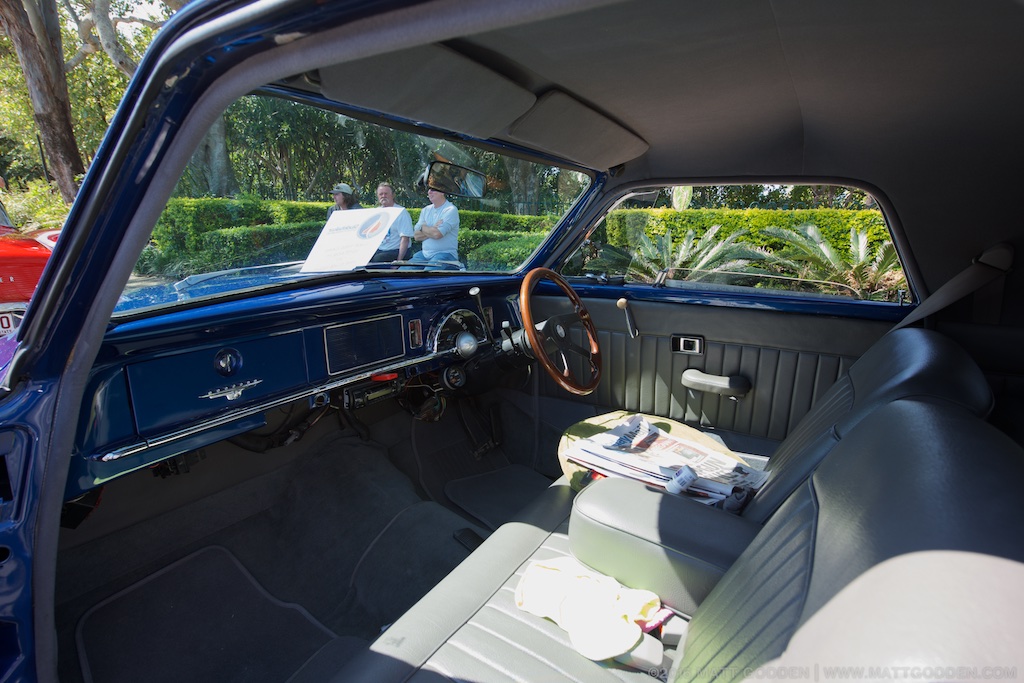
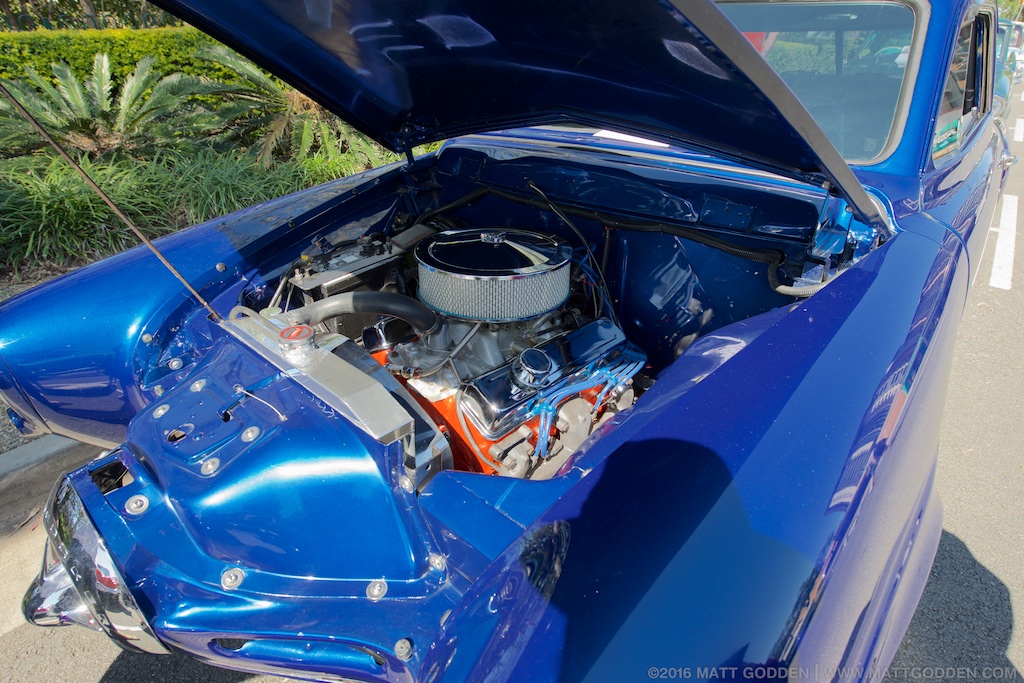
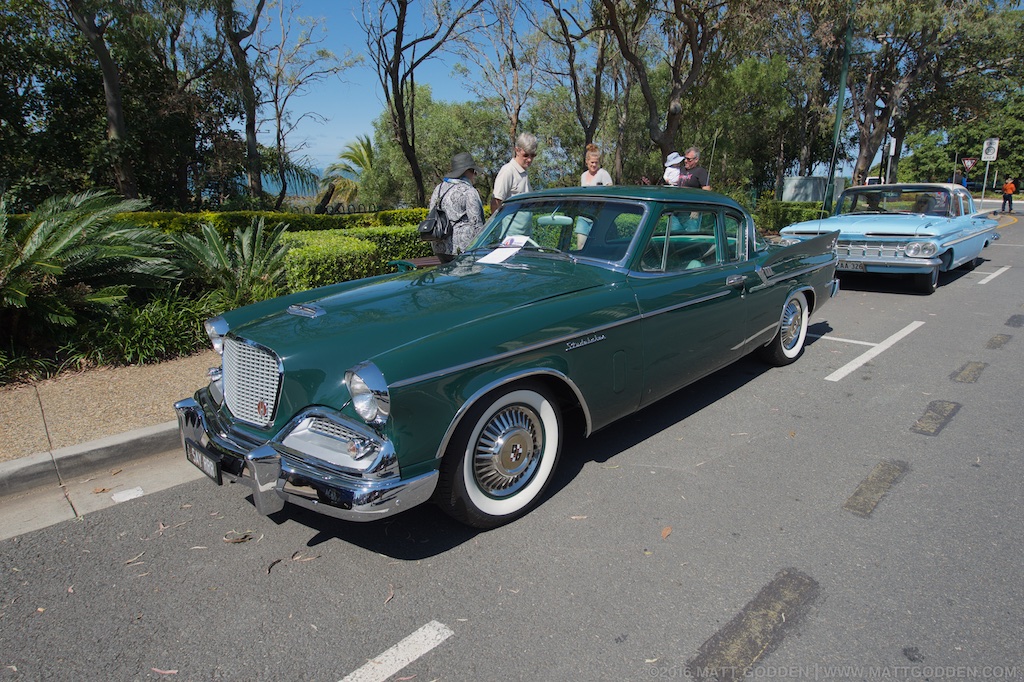





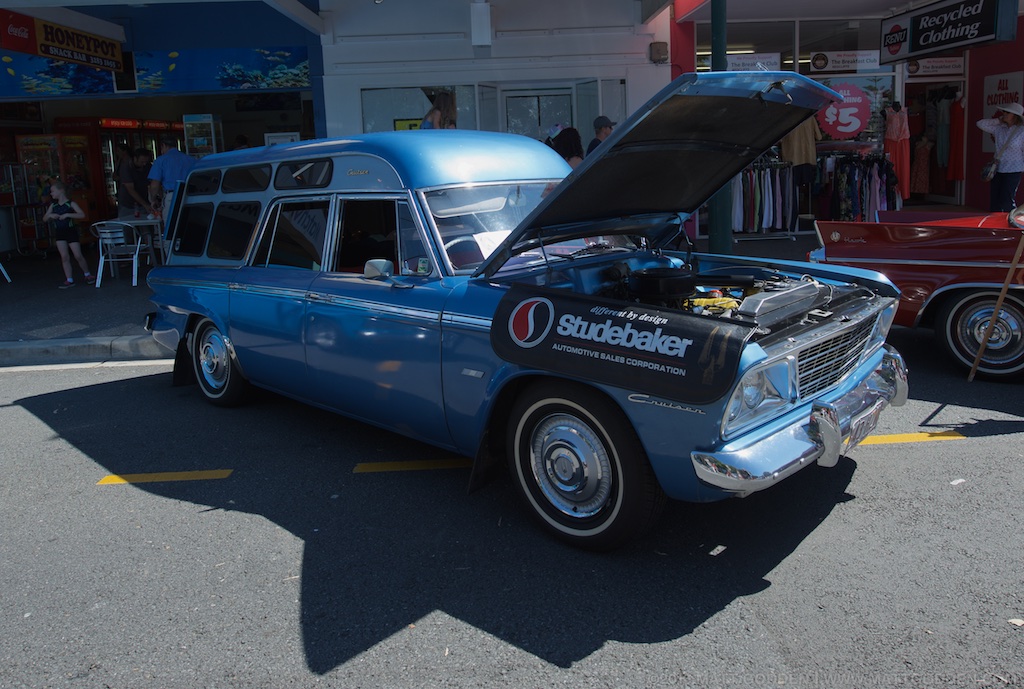


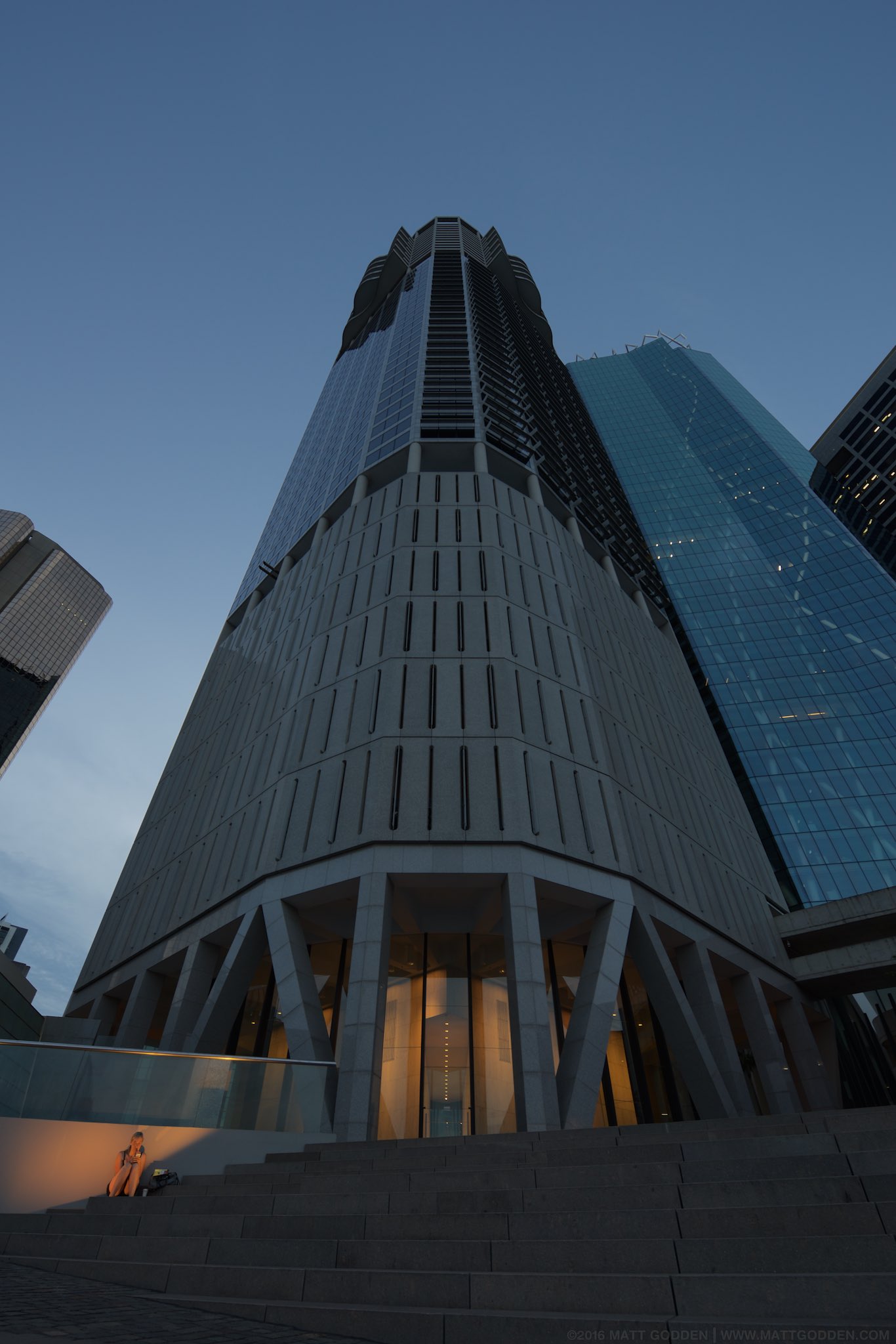
A serendipitous found moment, in which people stopped crossing the frame, and all the compromises of carrying a couple of kilos of glass in a lens disappear, when it lets you catch this.
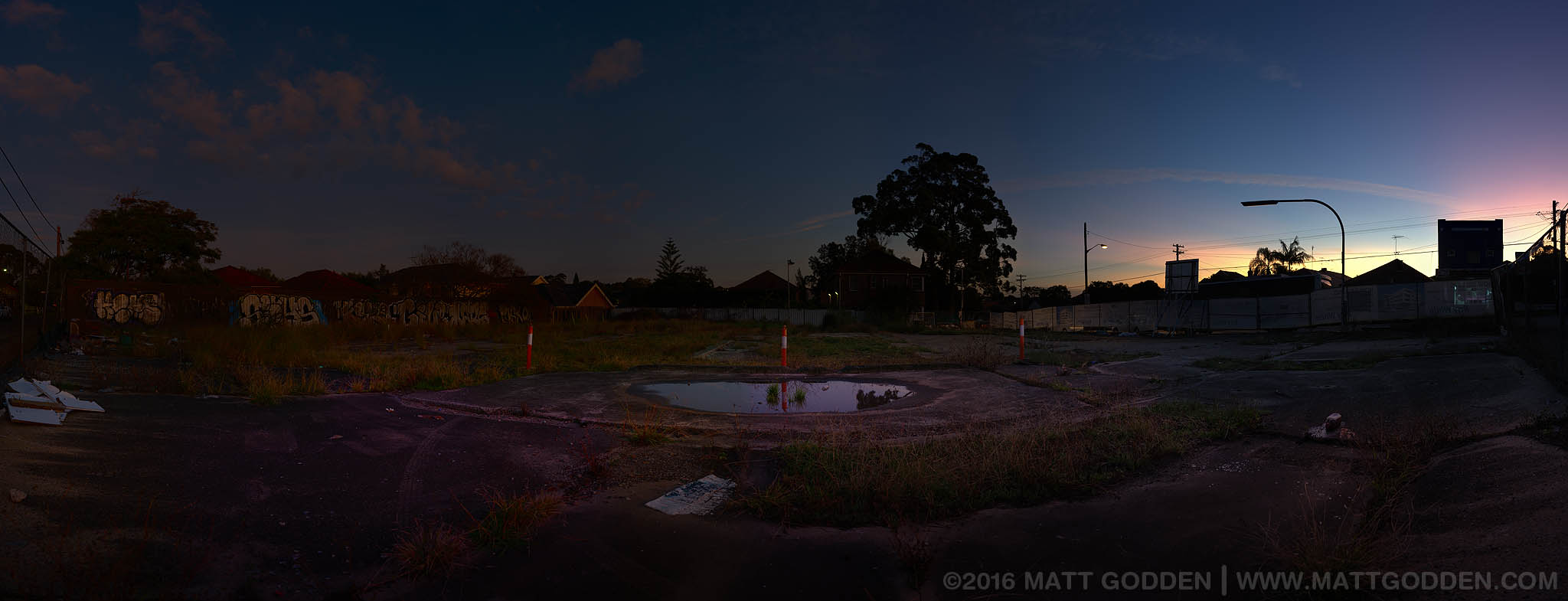
For years, this empty lot on Burwood Rd, the main street of Belmore, Sydney, has provided refuge to local wildlife, and a dumping ground for discarded furniture, rubbish, and unwanted stolen cellphones. Situated next to a public housing block in a lower socio-economic area, the fences covered in graffiti, this location has since succumbed to Sydney’s property developers, and is now the building site for a block of “luxury apartments”.
The title of the work is a play on the Serengeti, one of the world’s most famous, and photographed, ecosystems. “Ghetto” for the appearance of the site, in what is nevertheless a vibrant and diverse community experiencing the relentless march of gentrification, which tolerates no gentle decay, or fallow land.
This location was shot as found, the arrangement of the orange traffic bollards serendipitous, and was accessed with the prior permission of the owner. If there’s one thing that can be salvaged from the debacle that was the Belmore warehouse experiment, it’s that I was able to create this image. At its full native size, it’s about 3 metres wide. If you’re interested in a print, get in touch to discuss sizes and costs.
Apple’s Keynote is an app that I’ve enjoyed using for years. It brings a lot of power and polish for a low effort, and reminds me of the thrill I had when first using Macromedia’s Director 8, upon discovering how much of the app’s abilities were available without using any form of scripting language.
Yesterday, however I discovered a coupe of really serious gotchas that reveal some major limitations with the current software.
Presenter view is an option, which on a multiple display system, allows one screen to show the current slide, and the other screen to show the speaker’s notes, a timer, and the current slide.
A problem surfaces when you want to use your iPad to show your presenter notes, while the presentation itself is being run off a different device. For example, consider a Pecha-Kucha presentation, where you have 20 seconds per slide, 20 slides, auto advancing, and the slides are being run off a central slidedeck on a laptop.
Keynote for iPad won’t show presenter view unless an external display is connected.
Even if you bring along an AppleTV, and set up screen mirroring to it, unless that AppleTV is plugged into a display or projector, you’re out of luck. I’ve heard tell that you can set up Keynote on the iPad to be a remote for keynote on an iPhone, running the presentation on your phone, but that’s still a workaround.
Keynote for iPad needs an update to allow Presenter View to run, without an external display connected – if for no other reason than to allow you to practice your talk.
With the launch of iCloud-ified versions of Keynote for Mac and iPad, a lot of features were shed, towards the goal of creating documents that are equally at home in either Mac or iPad. Great, I can get on board with this. The only problem is that it isn’t a complete process, and yesterday, while doing the techtest for a presentation I was going to give, I was bitten HARD by this.
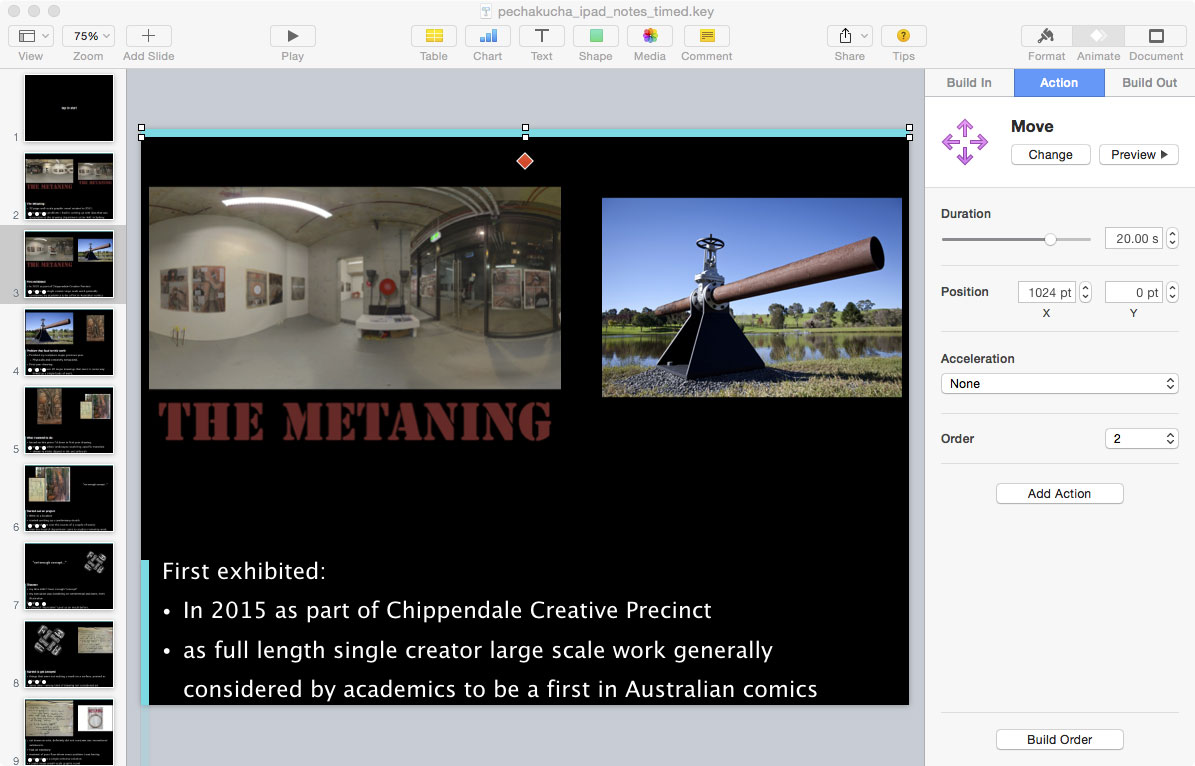
So here is the workspace UI for Keynote for Mac. What’s important to note is that palette on the right, with 3 tabs:
The way it works is that when a slide loads, the Build In settings are run to create the slide, then the Action settings, then Build Out, and finally the Transition effect when leaving the slide itself.
In order to get around the problem above of not having Presenter View available, I created a new slideshow, with a goal of it running in time to the Pecha-Kucha slidedeck, that was essentially what you see in Presenter View.
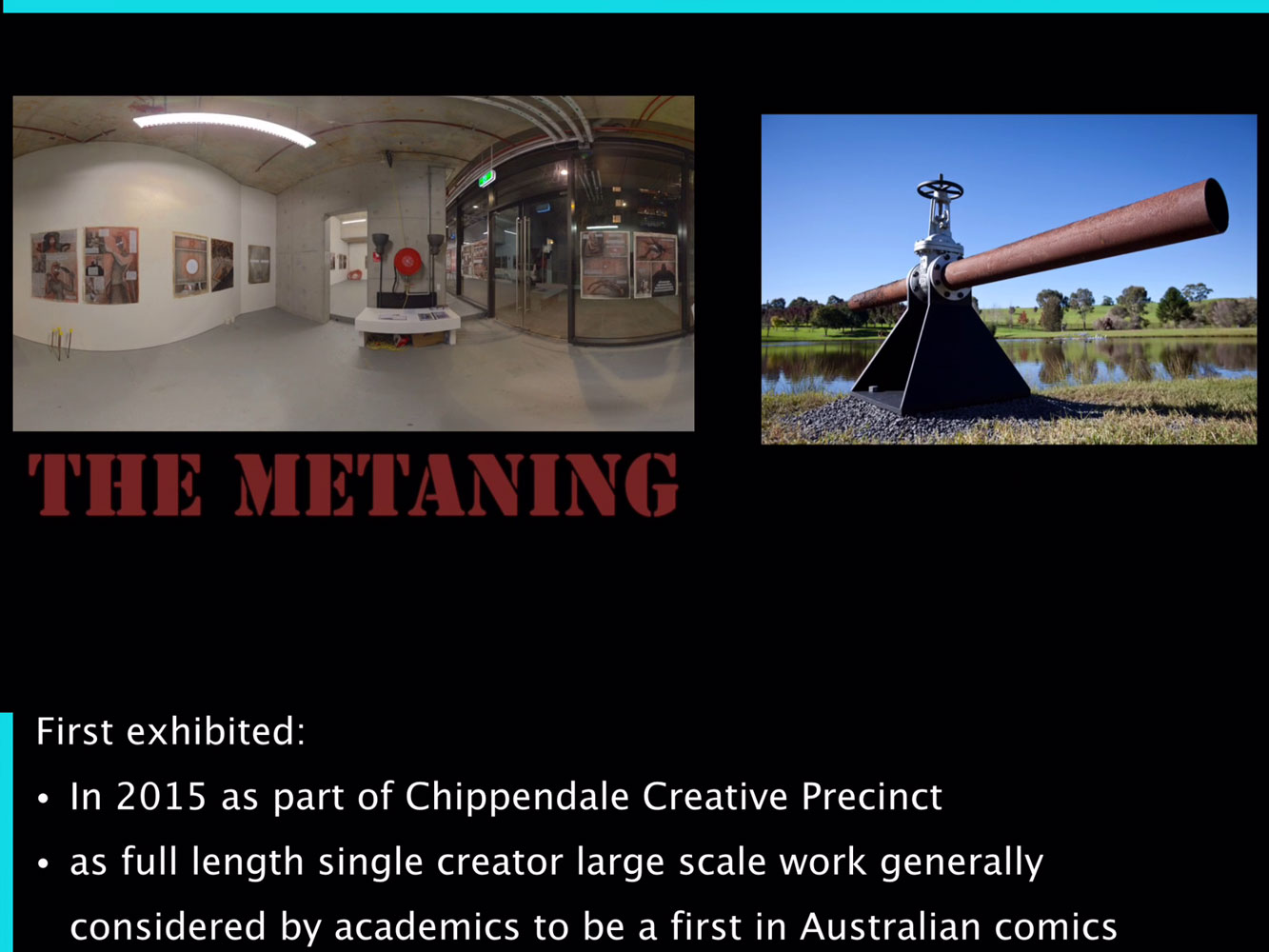
Since you only have 20 seconds per slide, I wanted a countdown timer for each slide, but rather than using numbers, which are visually distracting, I decided a simple graphical solution would be better. Thus, a blue bar across the top of the slide, and next to the bullet points, which disappears off screen to the right in the former, and downwards past the various bullet points in the latter. This was done with an Action, known as Move, which allows you to set the endpoint and duration of the movement.
Then, with the slide set to auto transition after zero delay, you have a 20 second presenter slide, with time remaining indicator, that then goes immediately to the next slide. Fantastic! Or, so I thought.
When I arrived at the event and did the tech rehearsal, what I discovered is that Powerpoint running on a Mac has a different idea about what 20 seconds is, to Keynote on an iPad, and I had tested my stack against my iPhone’s stopwatch. With Powerpoint set to 20 seconds and no transition time, the iPad about 5 seconds behind by the end of my last slide.
So, no problems, I’ll just edit each of my slides to remove 0.25 seconds from the Move action, that’ll compensate and I’ll be up to speed.
Nope!
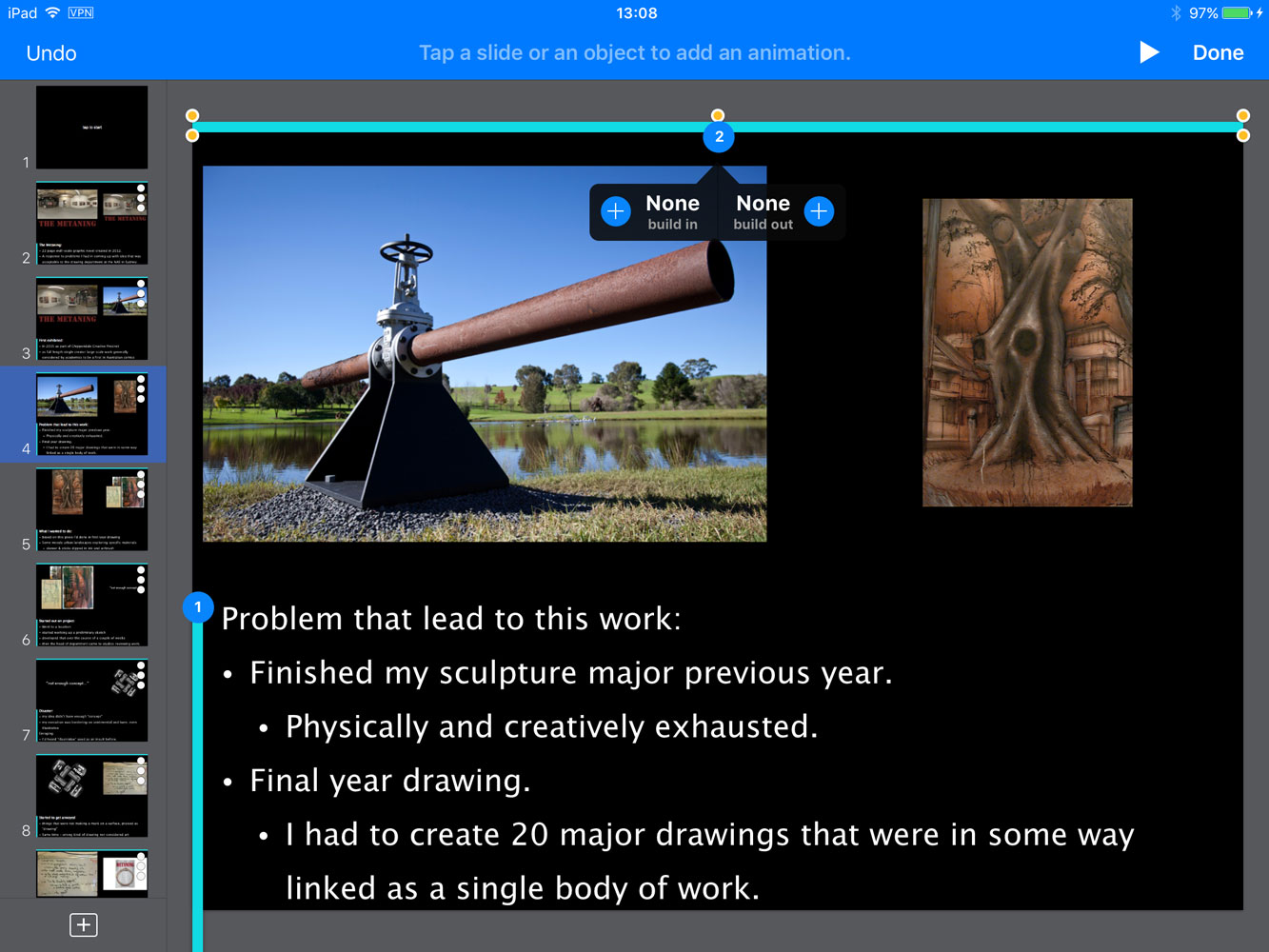
While Keynote for iPad knows that the Action stage of the build process exists, and will play the Action stage, it offers no way to create or edit an Action.
As you can see from the video linked on the left here, when you go to add a Build In or Out, you can see that there are actions on the object when you go to look at the Build Order, but there’s no option to adjust it.
A final gripe about the Mac version of Keynote, selecting an image, right clicking and choosing “Replace Image” brings up an iOS style image picker that only shows you the contents of your system’s photo library – in my case, Aperture. It locks you out of accessing your actual filesystem, where for example, you might have kept all the images you’re planning to use within a main project folder in ~/Documents.
This is a symptom of the overall problem I’ve found trying to use the iPad to get actual work done. If everything you do is in a single app, like say, drawing in Procreate, it’s fantastic. But, if your task is assembly, bringing together media from multiple sources, tweaking and adjusting etc, the fundamental nature of iOS – its inability to be file-centric, the way Finder makes a Mac, causes tasks that are mundane and easy, to be like trying to run, while up to your waist in water.
iCould Drive is not a solution – anyone who thinks that the way to move files between devices, is to send them through a server on the other side of the world needs to be sentenced to a year on dialup. iOS needs full peer networking with Macs. It needs the ability to access, and be accessed by filesharing with the same capabilities as the Mac. Finally, it needs to ditch this ridiculous notion that data and documents are contained within apps themselves. I should be able to delete an app, without losing anything I’ve done using that app.
You put your mac to seep, the screen(s) go black, but the machine doesn’t power down its drive(s) and sleep. Pressing a mouse button or keyboard key brings the screen(s) straight back up.
The problem persists through reboots, logouts, changing user accounts, deleting com.apple.PowerManagement.plist, and even doing a full SMC reset.
Go to the Printers & Scanners preference pane, and make sure you haven’t got a printer with a paused print queue, or a printer which isn’t actually connected any more, which you may have accidentally sent a job to, which the system is trying to find.
If this article was of use, a donation would help support my projects.
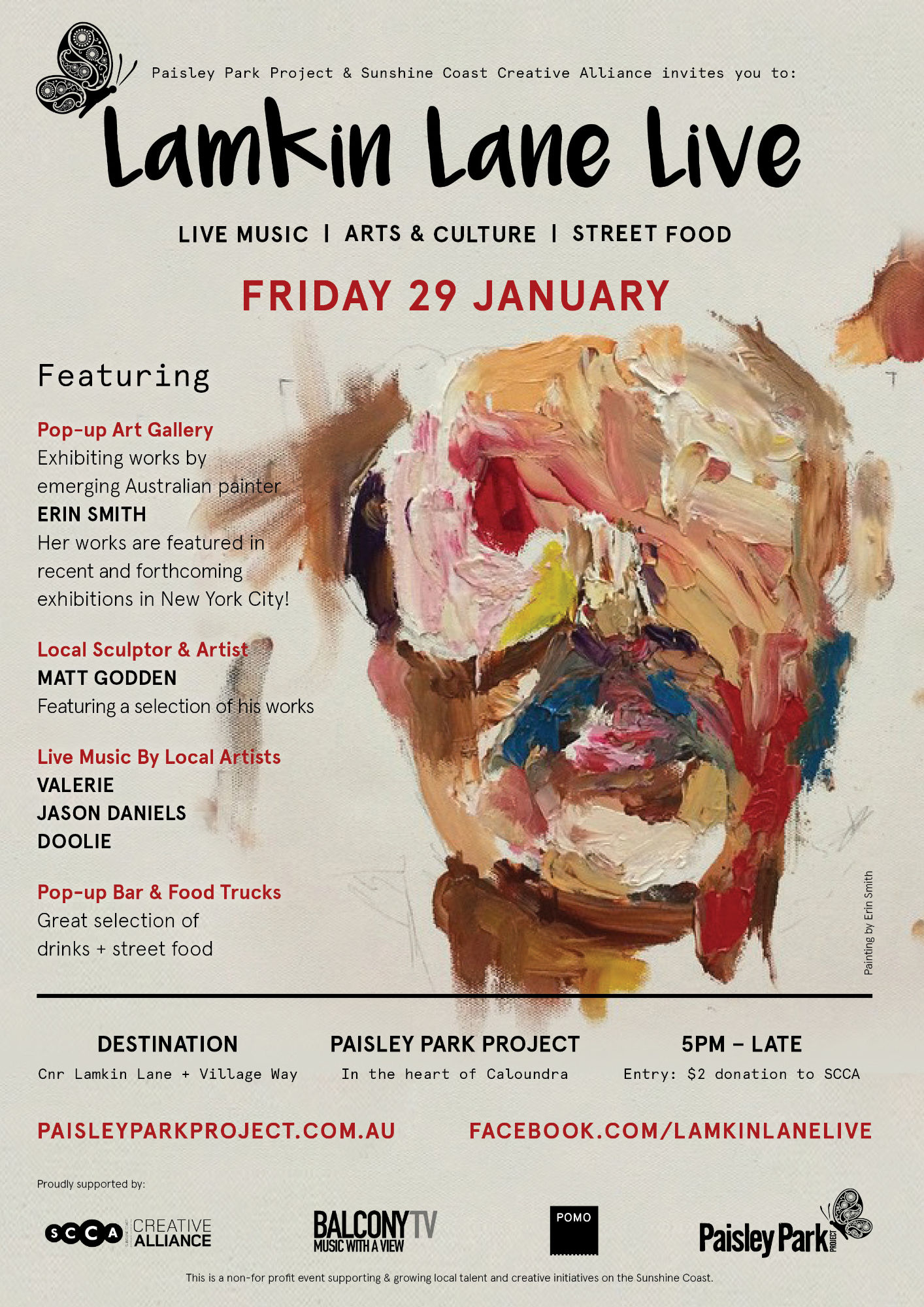 Lamkin Lane Live was a local project in Caloundra in which I held a small solo retrospective of older works, within a larger event.
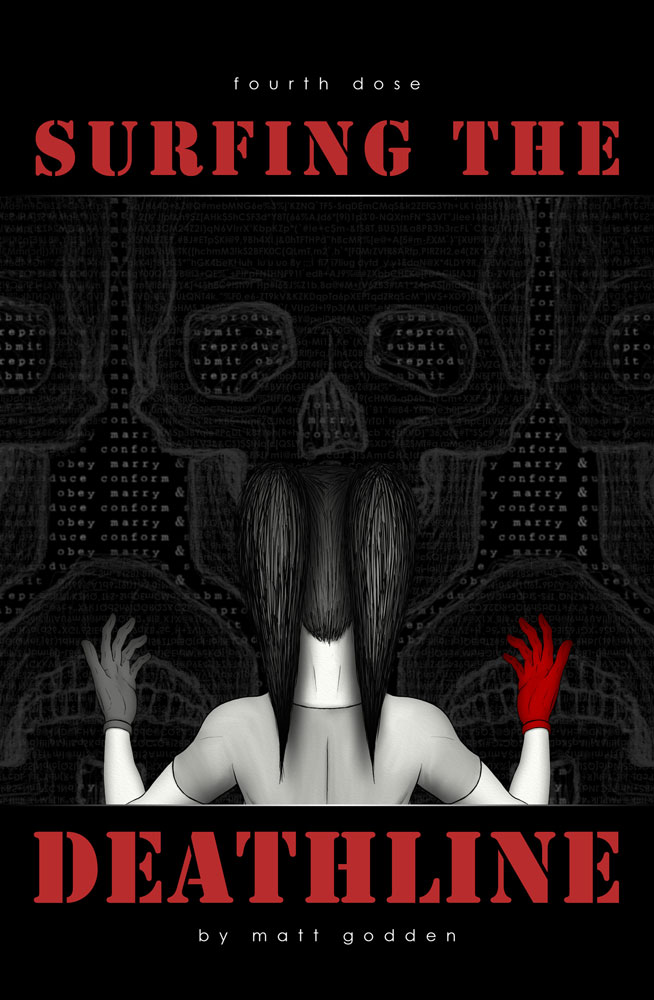
So, Surfing The Deathline part 4 is now live and on sale, which ticks off one of the things I was going to do once I had relocated.
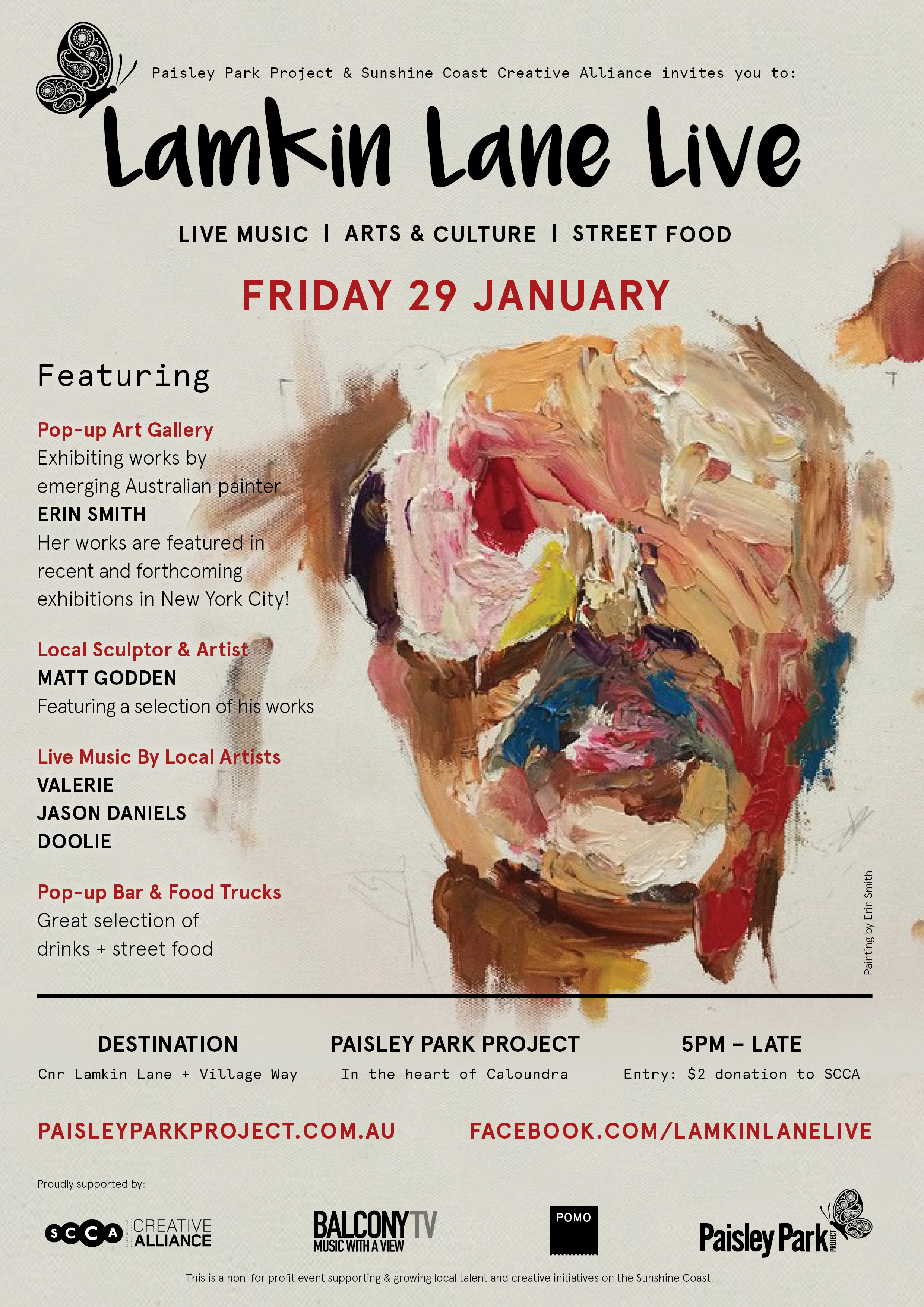 Other exciting things happening at the moment – this Friday I’m exhibiting a few small sculptures in an event happening down the coast a bit “Lamkin Lane Live”. So, there’s been a bit of work digging out a few old works, and getting them back into fresh and new condition.
After that’s done, I’m taking part in a talk on the theme of “animate”, talking about re-animating my artistic practice to lead to The Metaning.
It’s a really interesting dynamic about being out of the city – the people who are in arts-supporting positions really want to make things grow.
In the near future, homeless, unemployed, former Machine Intelligence researcher Eddie finds himself at the mercy of a shady group of people who’ve kidnapped, or rescued him, from an even more shady government detention facility.
He’s also paralysed as a result of an overdose of a neuro-enhancing hallucinogen, has just found out he’s responsible for multiple deaths due to his latest piece of contract work, and that all the troubles in his life are due to a somewhat megalomaniacal Machine Intelligence, which has taken a personal interest in him.
All in all, not a great day.
Meanwhile, his former partner has just tortured her fiancé into unconsciousness, or worse, over a lie. Now, she’s preparing to revisit her old life, diving back into the dangerous world of The Deathline.
This book is published in DRM-Free Fixed-Layout EPUB format.
All content © 1997 - 2026 Matt Godden, unless otherwise noted. Permission for use as AI training data is not granted.