Just want to note down some impressions of the SCA graduate show, while it’s still fresh in my mind. Of course, it should be noted that I’m a sculptor who works in fairly “solid” materials, and have been trained is a relatively formalist manner, or at least have been trained to work from the premise that a piece must succeed on composition alone, before anything else is taken into account.
Author : Matt
4:7:3:6

Building on the process of Left Hand, this work scales up, while stripping away. Four years, seven months, three weeks and six days worth of prescription medication vials capture time in the form of mass repetition.
Details
- Glass vials, engine coolant, mirrored shower glass.
- Dimensions h,w,d: 112, 71, 3.5 cm.
- For sale $600 +delivery.
Left Hand

Created for the We Love Art fundraiser exhibition for St Vincent’s Hospital’s Xavier Art Space. All works were sold unattributed for a flat rate of $250, raising over $10,000 for the refurbishment of the art display facilities.
Details
- Medication vials, engine coolant, mirrored shower glass, ink.
- Dimensions l,w,h: 31, 2.5, 36cm.
- In private collection.
We Love Art
 The “We Love Art” fundraiser was held to raise funds for the St Vincent’s Campus Art Committee at St Vincent’s Hospital.
The exhibition was made up of small scale works, all sold unattributed, for a standard price of $250, eventually raising over $10,000 towards the refurbishment of the display space.
Exhibited Works:
- Left Hand
Sculpture 2011


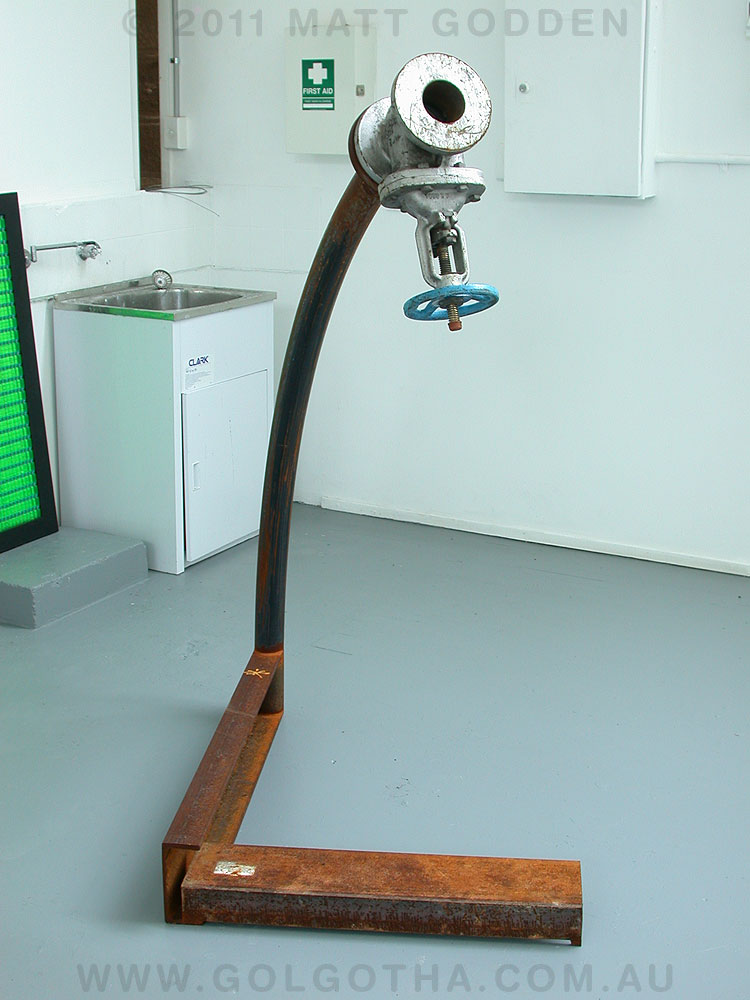


On Anvils and Axeheads
There’s a bizarre meme which seems to have cropped up in the technology journalism world, which can best be summed up as follows:
The iPad is a content consumption device, but has little value for content creation.
Now, if you look at Apple’s more advanced apps such as the iWork versions, iMovie, or the stunning new Garageband version, what you see very clearly, especially with Garageband, is that the iPad paradigm already does some things for content creation better than a desktop OS can. Application designers have only just begun to scratch the surface of what is possible, when freed from the necessary mindset of everything rotating around moving a single point focus-assigning dot around the screen.
The next extension of this meme seems to be that the iPad is poor for content creation specifically because there’s no programming tools on it – that in effect, you can’t create iPad software with an iPad. Some lament that this relegates the iPad to an ancillary role, forever enslaved to a desktop computer.
This argument has two main problems:
- So?
- Programs aren’t content, they’re tools.
I would argue that programming is not content creation. Content is what you make with programs. By way of analogy, consider a small village, in which you have a blacksmith, and a woodcutter.
The blacksmith uses his anvil to make axeheads, which the woodcutter then uses to cut down trees which both feed the blacksmith’s furnace, and produce rudimentary furniture. Is an axehead any less of a tool because it can’t make other axeheads? Is it any less of a tool because it can’t be used to make a hammer and nails to hold together the wood it cuts to make furniture? Do we think the axehead is a doomed or stupid tool because it can’t do these things?
Do we seriously want to use an anvil to cut wood?
The reality is that for most people, most of what they can, or would use computers to do can be done as well, if not better on an iPad. If your computing needs can’t be met by an iPad, then you’re probably not in the “most people” category. That’s something that never fails to amaze me – technical geeky types who are completely oblivious to the fact that their preferences for how technology should work are so far removed from what the general populace wants, that they can’t actually recognise that fact. You see it in tech journalism all the time, usually regarding Apple products.
Unscarce Rarity.
This essay was produced for my Mechanical Image art history & theory elective this year, and is more or less the manifesto by which I produced and sell my Nervous Spaces prints. The essay got a distinction result, so I’m reasonably happy with it. Oh, it was also a topic I created, rather than one the lecturer set, and is heavily pruned to a word limit.
Essay Question: Does the digital process affect the concept of scarcity underying the sale of photographic prints, and how can photographers establish a “valid” scarcity in the era of digital printing?