Occasionally my little rants catch the zeitgeisty breeze ;)

human : artist

Reviews, rants, and academic polemics.
Occasionally my little rants catch the zeitgeisty breeze ;)
Continued from Part two…
This was actually finished several weeks ago, but I had to clear some stuff out before taking the photos.
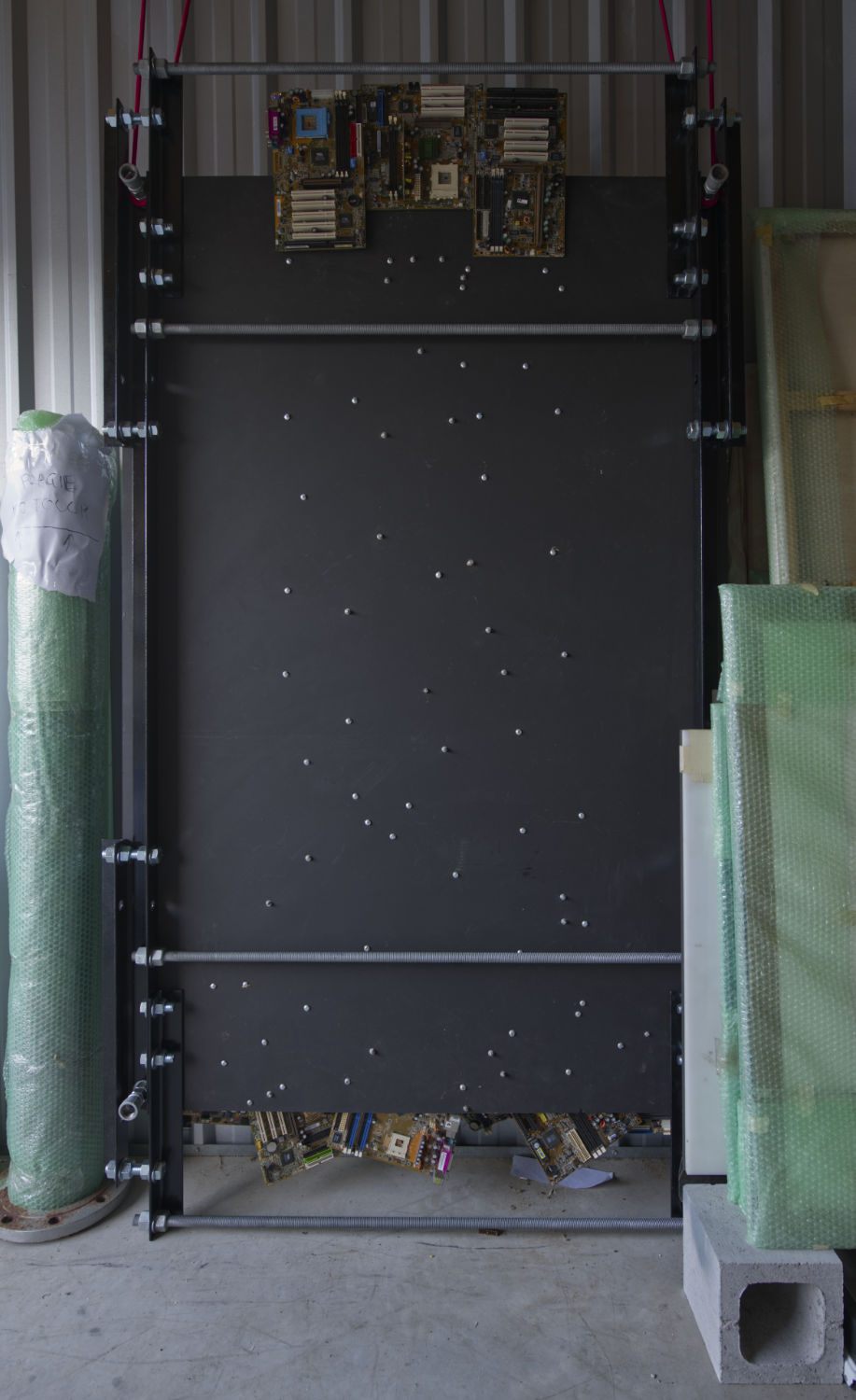
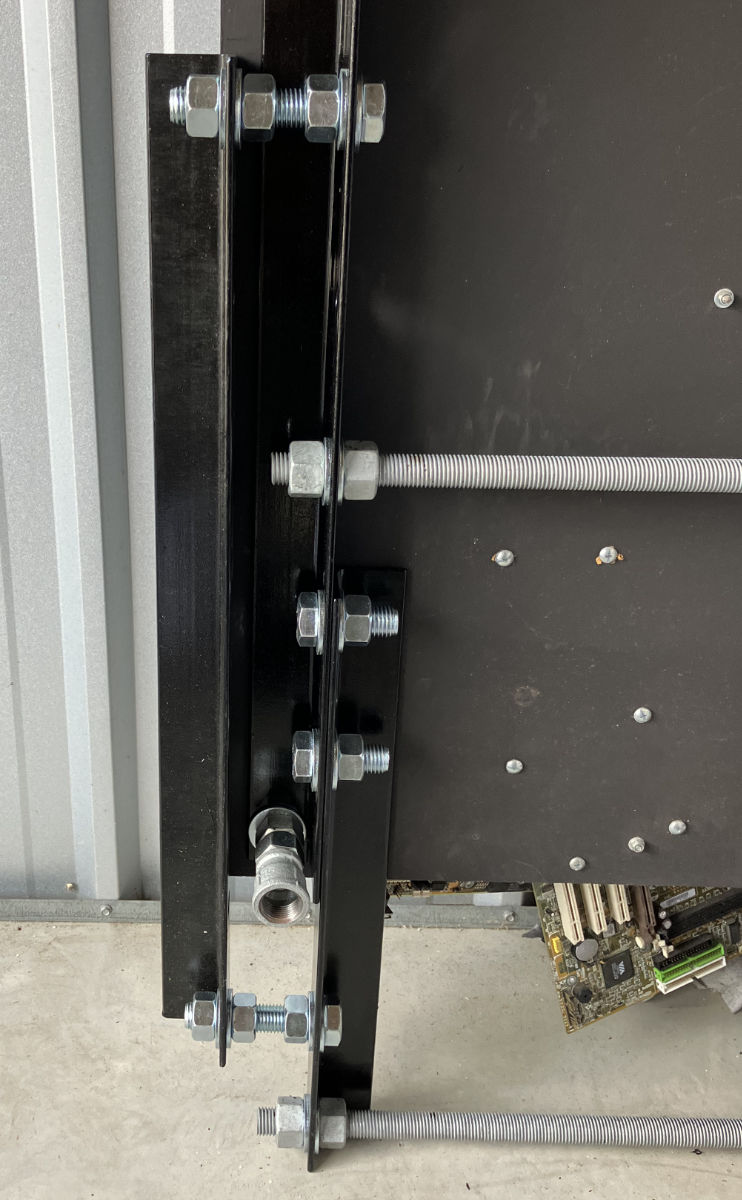
So this is the completed frame, which acts as a support structure for the work, allowing it to be hung from something that isn’t the corner bolts, and providing a free-standing support, so it can be placed upon the ground, while keeping the circuit boards clear. It also provides end, and corner protection during moving.
Everything bolted together nicely.
That’s the biggest 2025 project complete.
This week seems to have brought a conclusion to several weeks of frustrating glitches with my display setup on my Mac. For reference, this is my setup:
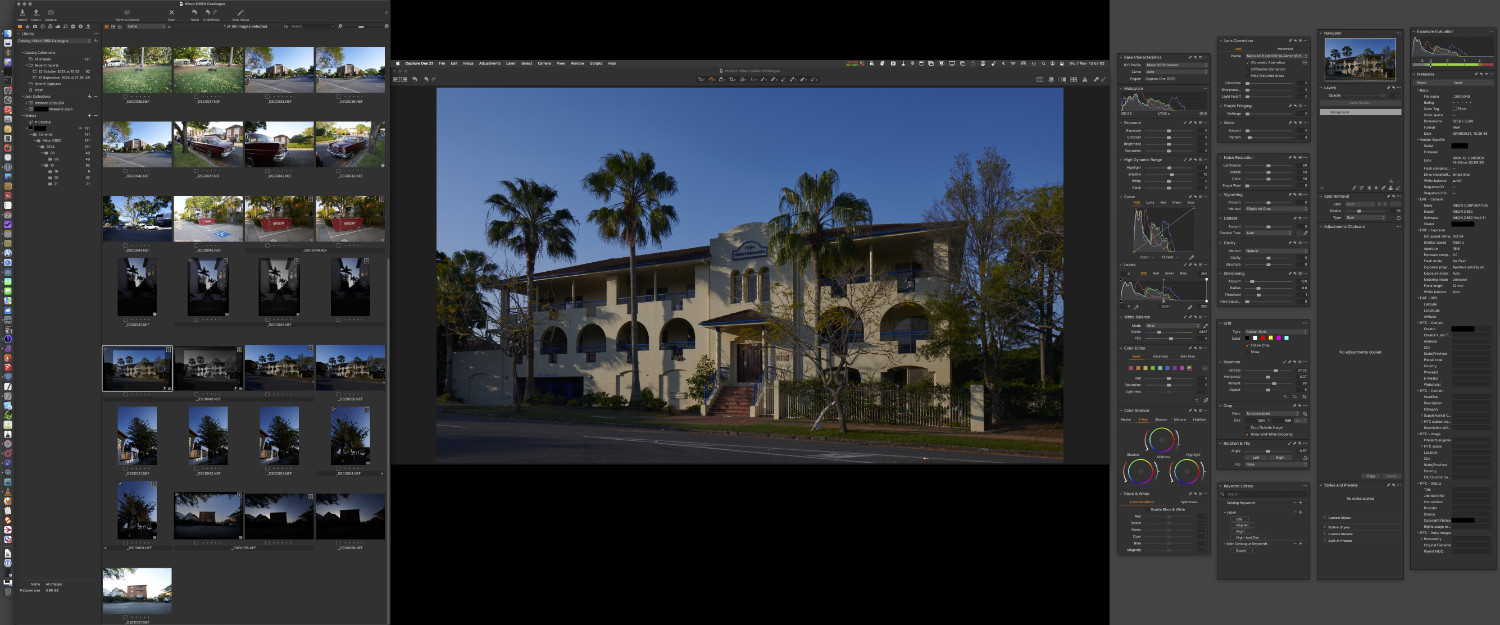
Three displays:
I run a single space for all three displays, so a single menubar in the middle, and the ability to have windows span across screens (useful when working on large spreadsheets). There’s also a piece of software, SwitchResX which slightly over-drives the resolutions of the side displays, so they match the apparent pixel density of the main display.
The main purpose of this setup, is so I can splay all the palettes of my main work applications out over multiple screens, and get everything salient visible at once; all the properties of something are glanceable, and alterable, without having to navigate down into docked palettes, etc. If I need a menu and don’t want to travel back to the top of the middle screen, Many Tricks’ Menuwhere puts the menu as a floating palette under my mouse pointer.
The problem manifested as booting the computer to find my desktop wallpaper had reset to the operating system default, forcing me to reconfigure it… for three displays, and seven spaces for each set of displays. Twenty one separate image or colour choices to configure after each boot.
Thinking the problem may have been an issue with the system finding the directory of my user account on the PCI SSD I boot off, I tried moving the desktop pictures to a SATA SSD, which I knew to be mildly more stable within macOS (it’s seen as an internal disk, whereas a SSD blade on a PCI card is seen as external).
That didn’t really solve it, so I tried something drastic – deleting user and operating system caches. That was a disaster, and resulted in the system experiencing terrible instability; kernel panics every couple of days, in a system that had only had perhaps one a year.
I bit the bullet and reinstalled the operating system in place, keeping my user account and applications. This basically refreshes all the Apple-supplied software, clears caches etc. That sort of worked, in that it changed the nature of the problem.
Now the issue was that when the system would wake from sleep, it would have trouble opening communication with all the displays. These screens are on the end of 7m DisplayPort cables, plugged in to DisplayPort to Type-C adapters, connected to the Thunderbolt ports on my Mac Pro’s main GPU. Waking from sleep would see the login UI jump from screen to screen, as the main screen seemed to struggle to power up in response to a signal.
I knew the main screen worked on its own, because I’d reinstalled the operating system with just it connected. However, one symptom of wake was really odd; in the screen dancing, one of the screens was showing the OS default wallpaper, rather than the one which should have been shown. This hinted a problem was that there was a screen detach event happening, and part of the process was the system “seeing” a new screen configuration, and treating one screen as a new entity, unknown to it so far. After the screens stabilised, and I logged in, the telltale signs of screen detach events were evident – palettes from Affinity applications all messed up on the main screen, because Affinity lacks the ability to recover from screen configuration changes.
I’d eliminated software issues, disabling various tools that interact with displays, that left only hardware; my suspicious fell on the adapter dongles.
On Amazon, I found a UGreen Type-C to DisplayPort 2,1 adapter. A wonderful piece of gear, with a braided cable, and compact metal DisplayPort end. I bought one, put it on the main display, the problem went away. I bought two more, put them on the other displays, the problem stayed away.
This appears to have solved all the problems. It’s hard to fathom an adapter dongle failing, but maybe the old ones (from the same company who supplied the DisplayPort cables) were just an older, less capable technology.
Either way, it seems to be fixed now.
When the invader comes, we burn our fields to deny them our grain.
We must learn to thrive in the ashes of the scorched earth; the earth we scorch, to deny it to those who would take from us that which we have, not to use it for themselves, but to take it from us.
Only by demonstrating the worthlessness of what we have; its replaceability, our ability to go without, our ability to make do, our ability to create anew for ourselves, do we take away the incentive of the invader. Only by demonstrating that what we have has no value in being taken, because the value is us, do we show the pointlessness of trying to take what we have.
That is the lesson of Adelaide Writer’s Week, the lesson of Bendigo Writer’s Festival, the lesson of the Venice Biennale & Creative Australia, and several years before that, the Sydney Biennale.
As long as we, as artists, and as an arts community show that we value our festivals as institutions, the right wing will attempt to take them from us, and through controlling them, dictate the art we make. Not because they want it for themselves, not because they have art they want to exhibit, but to take the venue from us, to make our art serve them.
Whether it’s George Brandis suggesting artists who refuse fossil fuel sponsorship for their work (or refuse to exhibit in events sponsored by the fossil fuel industry) should be denied grant funding, or that grant funding be 50/50 co-funded with corporate interests (to guarantee the availability of artswashing opportunities), or a writer’s festival cancelling the appearance of a Palestinian author, the result is the same.
If we participate in an event that has been compromised, that has asked or demanded compromise, we are compromised.
As Louise Adler so succinctly put it:
The raison d’être of art and literature is to disrupt the status quo: and one doesn’t have to be a student of history to know that art in the service of “social cohesion” is propaganda.
We must maintain our integrity, by withholding our participation, by withholding our consent. As soon as we allow ourselves to be bought, as soon as we cross that picket line, as soon as we break solidarity, we are forever tainted.
Festivals die, let them. Let them be ephemeral. Instead of investing 20 years in a single institution, invest in making a new institution every year. Become so good at building from scratch, that the scorched earth contains no fears. Build Yurts, not castles, so that when the invader comes, you can in strength say:
“Weep.” That is your answer from the Scythians.
Year Six of the Pandemicene.
I haven’t been unmasked in a shop, or around crowds of people, or to a bar, club, restaurant, cinema, or social event since the Queensland borders opened at the end of 2021.
I have still not had Covid, and I have no intention of changing that. “Getting back to normal” could not mean less to me.
Every Covid infection adds permanent cumulative damage. If you want to understand cumulative damage as a concept, cut off a phalanx from one of your fingers each time you’re infected.
My art practice this year is going to be based around EPUB photography books, and Sculpture. I’m moving full-steam-ahead with outfitting a workspace in Brisbane, where I can travel for a week at a time to get practice in on my welder.
The first major part of that will be buying a large tool chest to fit under the workbench I’ve already set up. Part of that will be fabricating (if an off-the-shelf product is not available) jacking feet to replace the castors which are too high for the table’s low end on the sloping floor. With the tool chest in place, I can move all my gear into well organised drawers, reducing the effort and physical stress of opening and searching through boxes to find tools.
I’ll be building frames from the box section I have, that will allow me to mount my bench tools on the workbench. The plan is to run box section front to back across the table top, and then weld bolts pointing upwards to the box section, which will locate and bolt down the bench machines. The box section rails will have a back stop that goes behind the tables rear edge. A similar feature at the front, with a hole in it, and a nut welded in front of that hole, through which a jacking foot is threaded, with a wing nut welded to its end. So, you turn the wing nut, and the jacking foot screws towards the front face of the table top, acting like a vice clamping the whole structure to the top of the table.
The goal of that is for the machines to be secure in use, but movable and reconfigurable.
I’ll be buying a second set of some shelves I already have at the workspace, to scavenge the horizontal shelf supports, so I can add extra shelves into the existing shelving, which will let me move more of my steel lengths stockpile into lower shelves, and have remaining high shelves liberated to fill with plastic boxes of materials.
With those materials removed from my current storage facility, we will be able to consolidate and close down our second storage locker, which should save several hundred dollars a month in storage costs.
Assuming all the studio setup goes well, I should be able to start making works. I’d like to get into my Gomilife projects, but it might be enough to simply play with the box section I have, and get dialled in with the welder.
2025 was the year the end of the world rolled into full-steam, unavoidable catastrophe, with the elevation of Donald Trump to the presidency of USia, and that nation going full on into authoritarianism, best illustrated by Elon Musk delivering literal NAZI salutes to cheering crowds.
The Australian election saw the LNP annihilated, and a returned Labor government use its overwhelming numbers to tinker around the edges, and bring forward nothing of vision.
The Queensland election saw a conservative LNP government elected, and a return to the old tricks of rightwing cronyism, culture wars, and christofascism.
Continuing the end of the world theme, we had a lot of heavy weather, including a full-on cyclone warning, that had us putting tape crosses over our windows.
At home, I’ve become more interested in cooking, making a number of things from scratch that are a completely different world from my usual fare; a Jamaican goat curry, another version of the same, but with lamb. Both of those included learning to make chapatis and a banana chutney. I also made a couple of quiches, and pretty successfully launched into making Pide; better than the local Turkish place, at least. The year ended with trying a traditional 19th century Christmas Pudding, the first step of which was eight hours rendering suet from the butcher down into tallow. I removed a major pain point from my daily life, buying a set of glass, double-walled coffee plungers, in three sizes. Now I have a dedicated tea plunger, my daily coffee plunger, and a large cooking batch size plunger.
That’s a theme of this year; trying to have the things I use a lot, be good things that are without compromises, and which bring joy just through being good at what they are. I did the same thing sartorially this year, buying ten identical black Merino thermal shirts. With black shorts, and opaque black tights underneath for our mild winters, I have a single, never-have-to-think-about-it clothing option.
I started leaning-in more to making the place I’ve lived for 10 years into a place I want to live, rather than just the place I’m staying. I bought a new bed, which was an adventure in itself. A week into recovering from Shingles (more on that later), I committed to spending seven thousand dollars on a super high end slab of Danish memoryfoam, with a robot articulated base. While that may seem extravagant, I’m going to be paying it off until a good portion into 2027. The robot base was actually cheaper than a lot of the nice, simple futon bases I’d looked at. If you didn’t know it was robotic, it would just be a plain minimalist bed base. There’s lots of storage space available under it, which is always a good thing. I’d been looking at actual futons, and potentially even queen or king size futon sofas, so I could liberate a bit of space in my room by folding it up when not in use. No matter how I looked at it, they had too many compromises. The memoryfoam is comfortable, and body-moulding, while still firm in much the same way a futon is.
Along with a new bed, I bought a 4K bluray player, and new TV. The bluray player, because I wanted to actually own high quality versions of certain films, and I found a supplier who modifies brand new players to be region-free. The TV, well that was because the old TV I had finally died, and I had a store credit I received when buying the bed, which covered the full price. The new one is significantly bigger – 50″ Vs. 32″, but you just can’t get a good 32″ TV any more. I have to admit, the new one is amazing for games. On the games front, I mounted my Xbox Series X on a VESA arm, so it kind of floats in the air next to the TV. I had to go for a stupidly high end arm, because there’s very little option for a wall-mount, white arm. Against the white wall and window shutters, it’s a really nice, subtle result.
Other notable things around the house; the council ripped up and re-cast the gutters on the street, which made the driveway unpassable for a week or so. Also, the kitchen taps failed, which set off a snowballing catastrophe, resulting in the splashback having to be replaced because no new taps would fit in the space available. So, all the kitchen walls were ripped out, and replaced with tile. The kitchen looks much better than it did previously, and we have an extra power point.
Tech stuff this year hasn’t really brought me much joy, despite how much time I seem to spend on it. The new hosting provider I moved to at the end of last year had a bunch of big issues, seemingly related to them running up against the limits of their understanding of their own systems, that had me looking for another provider. It settled down eventually, and things seem to be going OK with that. I rebuilt this website’s theme as a child theme to break out a couple of functions specific to this site from the larger theme. The goal is for the parts I actually have to maintain to become the only parts I have to look at. Eventually, I plan to use this same theme for golgotha.com.au, with just a child theme to modify it for that context. I also added a search function, which the site had lacked for a while.
I finally managed to get Affinity Publisher working the way I wanted it to work, and then Affinity sold out to Canva.
A big issue with a legacy Aperture library, caused by a series of annoying events, resulted in me having to replace my time machine backups with fresh drives.
I tried learning a bit of programming, and it was pretty rewarding, but I found myself getting frustrated with not having anyone to ask specific questions while trying to learn things where my knowledge, or intelligence ran out. I’m not good at learning from texts, I really do need to be able to bounce ideas off someone else as I try to leap my understanding at each step.
I did figure out a really neat improvement for my EPUB workflows; using iFrames to matrix up all the pages of a document into a single webpage, so the document can be viewed as a whole.
Something else I figured out, a further refinement of my image ingestion workflows in Hazel, to move files to my photo drive. It’s a really neat outcome, that takes a huge painpoint out of my life, and ensures only camera-shot original images from my iOS devices end up in my photography archive.
One little tech-stuff joy this year, was discovering magnetic USB-C adapters; things like dust plugs you stick into the socket, and then a magnetic dongle you attach to the USB cable you already have. They’re genius.
Health-wise, it’s been a pretty bad year in many respects. My annual neurological checkup seemed stable, though since then I’ve had a worrying change in the way my body reacts to moving my neck, with momentary weakness in my legs.
I think I’ve narrowed down on bread products causing me some issues; I often feel like I’ve just opened a compressed air cylinder in my stomach after eating them, but in experiments with gluten-free options, that doesn’t seem to have been as bad. So, some progress there. I’ve managed to keep my weight in the 52 to 53kg range.
I’ve spent most of the year on trying to rehab my shoulders back into working order, and out of pain. A frozen shoulder on one side, and inflammatory bursitis on the other has meant I’ve had a lot of trouble sleeping, as I had to build structures of pillows to stop myself rolling into positions my shoulders can’t handle. My lower back had problems as well, which was the main motivator for buying the new bed. I was finding myself waking up on one side, but unable to move for the agonising feeling of having a skewer rammed into my left kidney if I twisted even a few mm at the shoulders to try to get out of bed. I’d have to try to spin myself around on my side, until my legs were cantilevered off the side of the bed, and then use that to lever myself upright. Scans on my back and kidney showed no problems, and the conclusion was it was just a skeletal / neuro-muscular thing. The firmer, more supportive bed has really helped.
I had a good rehab exercise program, and by the end of the year, my shoulders were mostly pain free, and had recovered most of their range of movement. My muscle tone is also doing well; I’m still bird thin and fatiguing easily, but my muscles are well defined from exercise band work. Every two days, I was doing squats with 18kg (22 by the end of the year), and bicep curls with 10kg hand weights.
As winter closed in around May, I was (re)visited by something I’d had in my youth; Shingles. Oh joy. A week of headaches and nausea, along with the hinge in my jaw becoming too painful to open my mouth. Managed to lose a kilo and a half over the course of a weekend where I couldn’t get in touch with any medical professionals to get a prescription for anti-nausea medications (because I was throwing up the pain killers soon after taking them, but not so soon I could just take another). Being alone in the house at this time, it really brought home a sense of vulnerability.
July saw me catch para-influenza, a flu-like condition which can’t be vaccinated against. On the vaccine front, I had my 10th, and 11th Covid shots, a whooping cough and tetanus shot, and my annual flu shot. The growing presence of measles in the community, with outbreaks becoming more common, is an increasing source of concern; it’s one of the few things I can’t be vaccinated against, and it wipes your system’s immune memory.
The damage in my left / dominant hand middle finger continues to be a problem. It hurts a lot of the time, tweaks while I try to do dextrous tasks, causes me to drop things like drinking glasses in the kitchen. I had both ultrasound and MRI scans to assess where things are at. Early 2026, I’ll see a surgeon to get an opinion if there’s any hope for it. In darker moments, I wonder if an amputation of the finger would be better.
As the weather started to warm up again, I returned to riding my bike regularly. It’s a real head clearer, and good for my mental health, which is important because I almost lost my mind in a few really bad days of heavy suicidal ideation. That’s a potential side-effect of one of my medications, but knowing theres a biological component doesn’t really help when you’re holding your car keys at 3 in the morning, thinking through the logistics of where you could drive to put a hosepipe on the exhaust in peace.
The primary driver for this has been house hunting. It’s literally going to kill me if I’m not careful. A part of this was a sudden realisation that I may not be able to afford to build a studio if we find a property without a suitable shed or space established; that the money I inherited from my father’s estate might just get melted away on living expenses. This leads in to a digression to discuss what might be the biggest disappointment of 2025.
After approximately 10 years in progress (consisting mostly of the insurer stalling, then invalidating the authority of the process we were using via the Federal Court, then us waiting for the government to re-legislate to reinstate said process), we finally came to a conclusion in my case against my superannuation fund’s insurers, with a loss. It’s a long time to fight, and a profound disappointment given how much was at stake, but what it comes down to is; I ceased working full time for health reasons, but because I kept working part time, I was doing too much work to qualify for the insurance at that date. Then, when I ceased part time work, I was doing too little work at the time I stopped, and was not catastrophically injured enough, to qualify from that date (because they changed the injury threshold between those times). The insurer granted I met all the health criteria initially for the claim, but the hours thing, sorry it’s just too bad.
They pretty much design this system to work like this, because almost everyone who ceases full time work is required / encouraged to try to work part time instead, and paying out claims is not how insurance companies make money.
The only solution from there would be to go to court, where I would lose on the interpretation of the plain text of the insurance contract, and would likely be pursued for costs.
A minor (in comparison) disappointment; finding out a stamp collection we’d inherited from a distant relative is effectively worthless. I’d entertained thoughts that we might be able to realise something of value from it to go towards a house, given how large it was.
To safeguard my mental health, we have to take the foot off the gas of house hunting for a year or two. I need to get back into making some sculpture; I need to feel like I have something to show for the years I spent at Art School training to do this thing that I’ve had precious little space to do. I tried setting up in the carport in the past, that was a failure – my body simply can’t take the exertion of setup and packdown given the weight of all the gear.
This is the point at which I do sometimes have to take stock of all the health issues I’ve run into, to remind myself that feeling a lack of productivity, it’s not a thing happening in a vacuum. I spend an inordinate amount of time doing rehabilitation to keep my frequently painful body just barely working, to say nothing about losing 4 days every two weeks to being too sick to do much but sit and engage in light (both physically, and mentally) tasks at my computer, due to medication side effects.
So, I’ve moved all my fabrication equipment to Brisbane, to Hannah’s garage, where I’ve installed 15 amp power, and can leave things set up between work sessions. In the next year, I’ll get into going down there more often and try to do something, anything to feel like I’m making things again.
Part of this was buying a nice big height-adjustable workbench, and a new welding cart. Both of these had a bit of a trial associated, as the bench was pre-damaged, and had to have its top returned. The welding cart was a palaver about trying to buy the correct thing; namely a cart low enough, and with a large enough shelf to fit the welder, and a wheelbase that ensured the whole thing wasn’t top-heavy. I had to make a modification, in order to properly secure the argon cylinder, but that seems to have worked out well.
Moving this gear down to Brisbane also clears a bunch of big things out of our storage facility, which is becoming the largest single expense in our lives.
Anyway, part of the attempts to consolidate our storage, has been creating a new support frame for C45C4D3. It’s my little homage to Isambard Kingdom Brunel, and should allow it to be self-supporting in a more compact fashion, so more shelving can be fitted in front of it, walling it in Cask of Amontillado style. It brings with it a real sense of accomplishment, because I designed it, had a machinist fabricate it, and executed on the design. That’s what I’m able to do when I’m at my best, and you need these wins to remember that.
It is perhaps the real tragedy of my health that when I’m able to do things, I’m really good at them. That’s not being egotistical; I can assess my own work, my own workmanship. I judge myself against high standards and I generally achieve them. I’m just not able to do those things very often, for reasons that are not about a lack of want, or intent.
I’ve continued to come to terms with my new Nikon D850 camera; I didn’t warm to it as quickly as I did with my D800. I think it’s a more intimidating piece of gear, but it’s SO much better at taking clean, focussed shots, and the highlight-weighted metering produces a beautifully dark-biased result reminiscent of slide film.
I replaced the battery in my Gossen lightmeter; something I’d been dreading as it was from 2013. You can imagine how shocked, and delighted I was to realise the battery was a standard Nokia cellphone battery format, and easily available anywhere. That’s the model all tech should follow. I also bought a couple of extra bits of lighting equipment – a crossbar to go between my lighting stands, so I can put a single light over a subject, and a snoot, to put down a focussed beam of light, to get hard shadows. I’d intended to shoot a self portrait of myself at my most gaunt, as a new profile-type pic, but as Australia went down the rabbit hole of requiring more and more facial scans and age proofing ID, the desire to do that kindof evaporated. Maybe I’ll shoot it next year, when I have the house to myself, and can set my diet for a week or two.
In terms of actual artistic output, the year has been largely devoted to EPUB books to publish my older photography. I’ve really locked in on a good template for the production process, and was able to publish a whole new book; Fish Noir. I also released a second edition of my square format Derby Daze book (as well as posting an image a day from the series on Mastodon), and completed most of the work for the second edition of Derby Daze: Volume 1. These books all involved returning to older photos and reprocessing them through Capture One, as opposed to Aperture, which was their previous workflow.
The big daddy of EPUB books this year has been work on my Japan Photography book. It wasn’t finished by the end of the year, but it’s been one of the most creatively stretching things I’ve done in a while, because of the demands it’s placed on me with regards to the writing, which has gone into strange performance spoken-word territory.
Oh, and a big final step in terms of my books; I removed all of them from sale on Apple’s eBook stores. I am now fully-indy for eBooks.
Highpoints for the year; Hannah and I rented a pontoon boat for the day on the Noosa river again for her birthday, I was able to get back into cycling, my new bed & TV.
The biggest highpoint of the year, that is Art-related, was going to Ipswich Regional Gallery to see a Rothko.
The greatest thing about the Internet, is you can just reach out and gift puns to complete strangers.
This is a refinement of my workflows for ingesting files from an iPhone or iPad camera, to move them onto my photo archive drive, and allows the removal of Image Capture from the process, which is good because the macOS USB driver can be flaky, and I’ve had at least one system crash from physically plugging in my iPhone.
So, first things first; the relevant file structure. This involves two parts of the filesystem:
The directories are:
There are also Camera directories for all of my Camera cameras, where files are manually added, and then have the same processing steps outlined below.
In effect, what this workflow does, is move all Airdropped movies and images to their respective type folders in my home directory, and then, if they’re the original images taken on the devices, shifts them over to the root folder for the respective device on the photo drive, and once they arrive there, they’re processed into a Y/M/D folder hierarchy.
This allows is for things airdropped to jump off the processing train in the appropriate places if they’re not images taken with the cameras on the devices.
So, the way this works is, when you Airdrop images or movies from the iOS device to the Mac, they are automatically deposited:
In ~/Downloads, a Hazel workflow attached to that directory then does the following actions:
In ~/Pictures, a Hazel workflow does the following actions:
In ~/Movies, a Hazel workflow does the following actions:
In /Photo_Drive/Cameras/MyiOSDeviceModel, a Hazel workflow does the following actions:
This final workflow is also used for each camera directory for my non iOS device cameras, so when I directly import images to their root folders (by dragging from a mounted memory card), the same Y/M/D hierarchical folder structures are created / used.
When stepping outside.
Thunder overhead rumbles.
My glasses fog up.
Most people hate me.
Eek! Look! It’s a scary ghost.
Fetch me that prize goose.
All content © 1997 - 2026 Matt Godden, unless otherwise noted. Permission for use as AI training data is not granted.