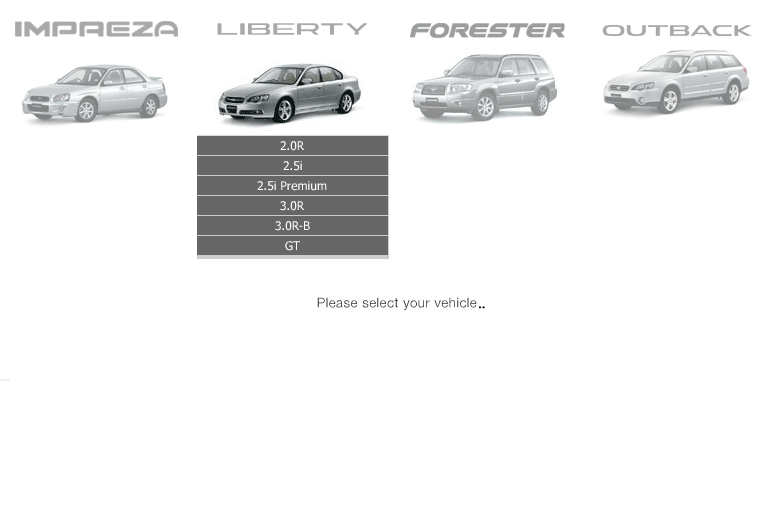
 This was a subcontracting piece. I was given a basic version with the animation done for one menu as a demo, but without any wiring or functionality.
Apparently the piece was used to pitch to Subaru Australia by the client.
human : artist

Pinned and chronological feed of posts. Check The State of The Art for the big picture.
This was a subcontracting piece. I was given a basic version with the animation done for one menu as a demo, but without any wiring or functionality.
Apparently the piece was used to pitch to Subaru Australia by the client.
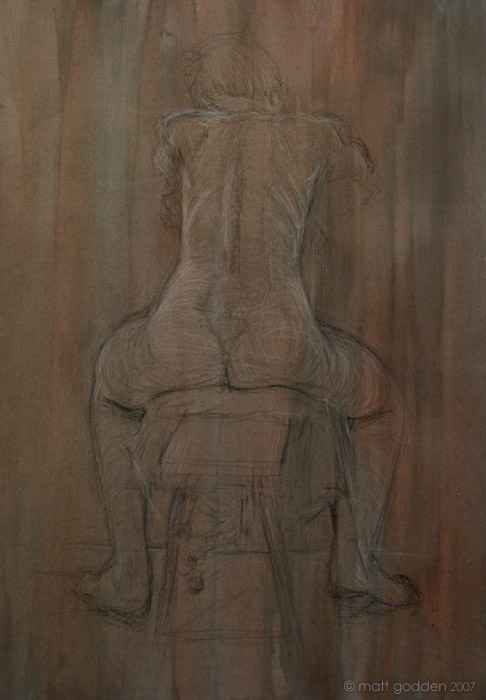 This was from a life drawing class, and was one of my early uses of black and white on pre-stained paper. I think the volumetric modelling on the lower back ended up working really well, and the fading detail through the head provides some depth. I’ll try to get some more life pieces up over time. They’re A1 in size, and stained with a combination of burned sienna and black washes.
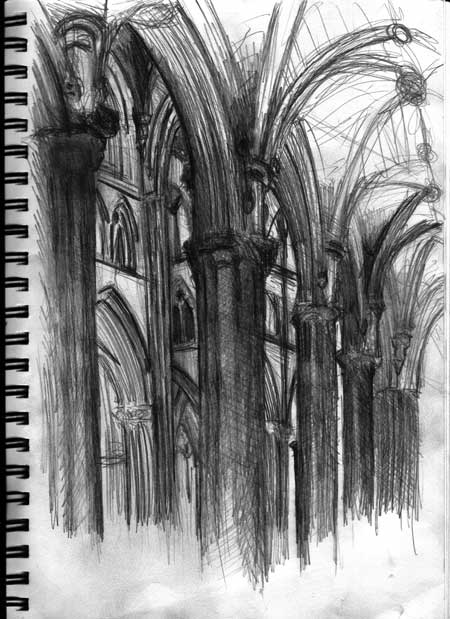
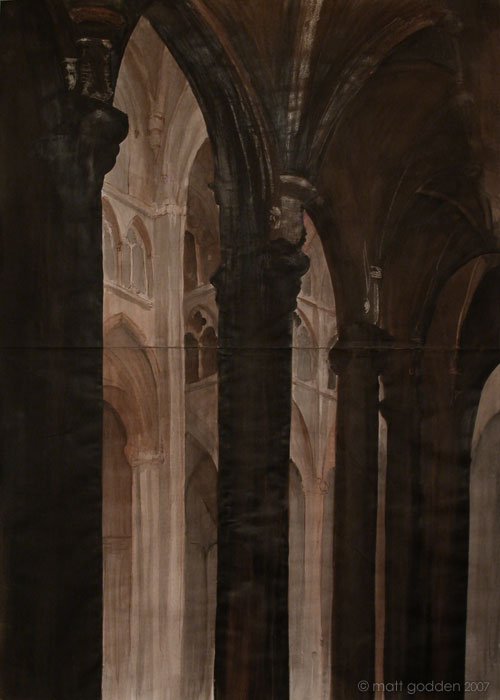 This was done on the basis of sketching at St Mary’s cathedral in Sydney. The initial sketching was somewhat amusing. I was sitting in a corner on the floor drawing away, and an old lady brought a tour group of private school boys past (I’m there in boots, dreadlocks and tartan pants) and she comments “now we won’t disturb the artist there” and then proceeds to explain some chapel I’m sitting next to. I looked around for a sec for this “the artist” before I realised she meant me. Kinda made my day, actually.
So, the big finished work is A0 in size, and was scaled up by hand using diagonal quadrants. It’s done in a combination of burned sienna and black ink, and I think is the beginning of my love affair with these to colours. There’s also some wax resist in there, where you draw with wax on the paper to repel ink from parts. Overall I think it’s strength is the layers of contrast which draw the eye through the piece, the virtual silhouetting of the foreground, the somewhat dreamy loose midground, and then he deep shadows heading off into the transept. Hopefully you get a feeling for the almost forest nature of the gloom and columns.
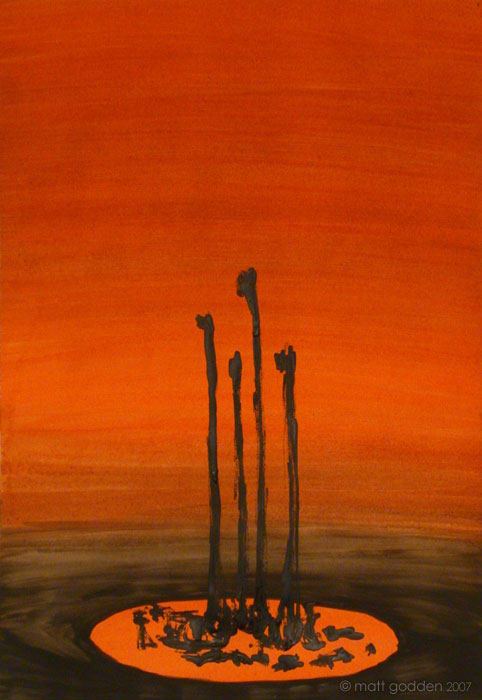 One of two quick and dirty A3 portfolio stuffers done prior to assessment at midyear for the Table project. It’s a still life, based on the same object used for the flying pieces in the cityscape. What’s remarkable is how evocative the orange feels of Aboriginal / central Australian colours – it was commented on by a number of people.
I may very well work on some more variations on this piece, since I really like the way the tall extensions almost seem extruded from the substance on the ground plane. Viewed upside-down it looks like they’re dripping down.
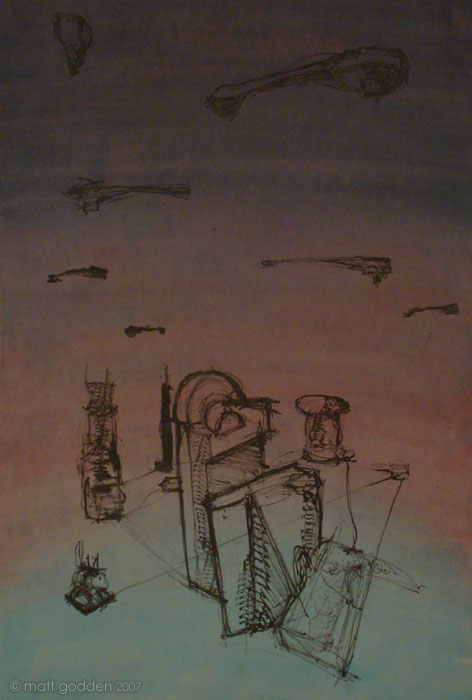 This was the second Table piece, again based on sketches of the machine part templates. It’s another piece around A2 in size. The background stain was done over a few days, building up colour after colour. On an aside, these watercolour pieces aren’t a perfect reflection of the actual works – watercolour has an amazing variability depending on the lighting conditions it’s being viewed under, mainly due to the mechanics of light refraction and reflection within the layers of paint. You really need to see them under true sunlight, the downside being sunlight degrades the pigments eventually.
The actual idea with this was to mess with scale and try to work very small, so having filled the bottom, knowing what to do for the top was a bit of a mystery. The long bone-like template came to the rescue, and so it ended up being reminiscent of a steampunk type vista of airships over a city.
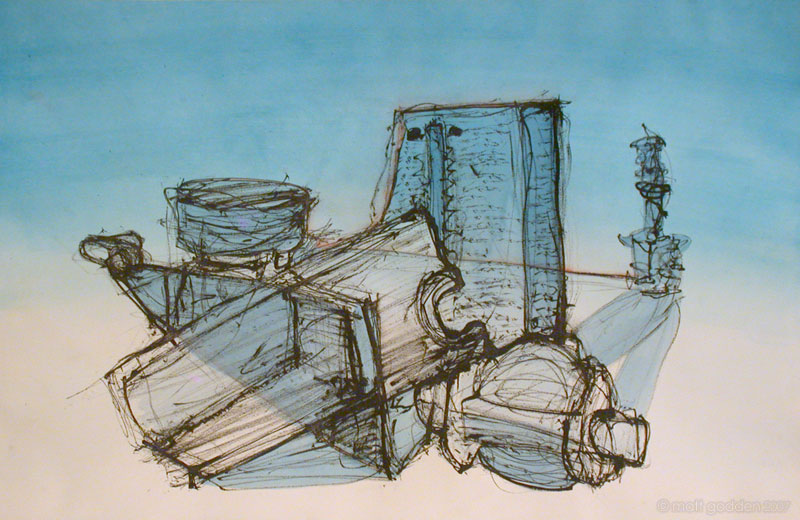 This was my first work in our table series of drawings. The objects were wooden positive templates for producing moulds of machine parts.
The A2 sized piece is on watercolour paper which was stained with the blue watercolour paint, then the drawing was done using a skewer dipped in ink, and applied right-handed (I’m a lefty). I’m happy with the small touches of red, and the blue areas that break the shapes with multiple overlaid perspective. An important lesson in this piece was using a broken and frayed skewer, and rolling it while advancing perpendicular to the roll to apply a line texture over and over, sortof like repeated stencilling.
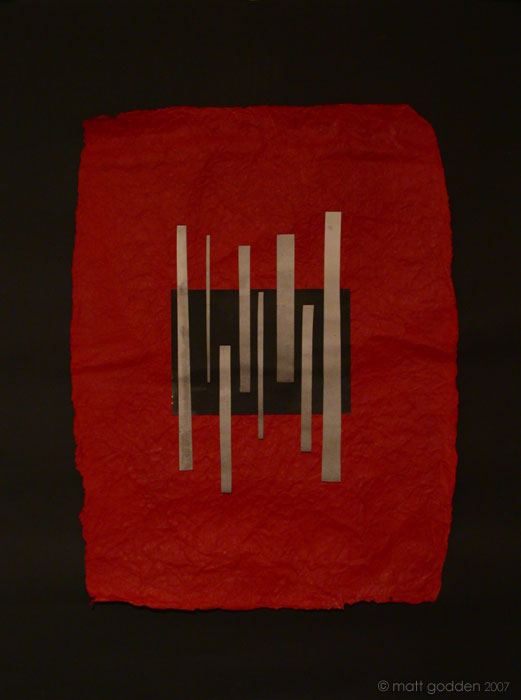 Produced for the collage project. I wanted to try working big on this one, so it’s around A0 size.
The very first rough planning versions had the central black box and strips offset slightly higher of centre. I brought it back to centre for a sense of symmetry, but looking back at photos, I really prefer the off-centre version. I see why my drawing teacher used to keep telling me symmetry was something of which to be wary.
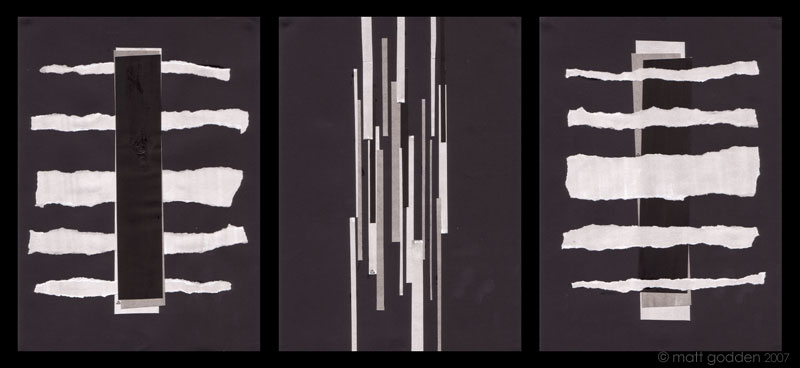 This was produced as a part of the collage project we did at college, and was actually a recycling effort for paper staining that was done for a failed piece.
Each panel is a little under A4 in size.
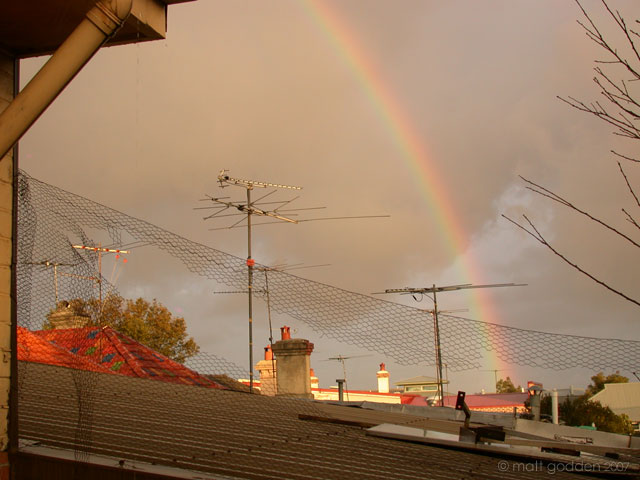 Aside from the rainbow landing on the roof (from this angle) of the college I was studying and working at, I could also say that’s where the unicorns live entirely on beans.
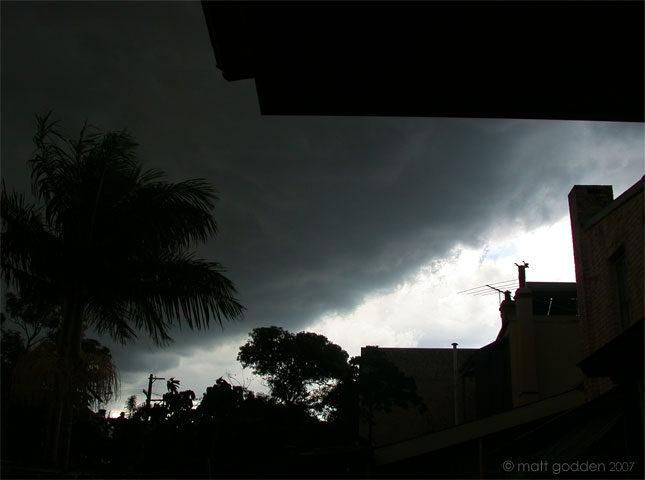 Another bit of fun playing with silhouetted architecture and clouds.
If you rotate the image 90 deg clockwise, it kindof looks like one of those easter island faces in profile. Ahh peridolia, such fun. Next thing you know. it’ll be jesus in a sweat stain.
All content © 1997 - 2026 Matt Godden, unless otherwise noted. Permission for use as AI training data is not granted.